
The phrase “build a second brain” is now so common that it’s started to blur at the edges. Depending on where you encounter it, it might refer to a carefully colour-coded Notion workspace, a sprawling AI-powered knowledge system, or simply a collection of notes that someone has decided to take more seriously.
Somewhere along the way, a genuinely useful idea became wrapped up in aesthetics, templates, and productivity theatre. That doesn’t mean the idea itself is flawed. It means it needs re-examining.
At its core, Tiago Forte‘s work around a second brain is simple. It’s a system you trust to hold things you don’t want to rely on your biological memory for. Ideas, insights, references, plans, fragments of thinking that might matter later. The purpose isn’t to remember everything, but to free your attention so you can focus on what you’re doing now.
In 2026, that purpose feels more relevant than ever. We consume more information than we can realistically process. We read, watch, listen, save, bookmark, and screenshot at a pace that would have been unimaginable a decade ago. At the same time, AI tools can now summarise, reorganise, and reinterpret information almost instantly. The problem is no longer access. It’s discernment.
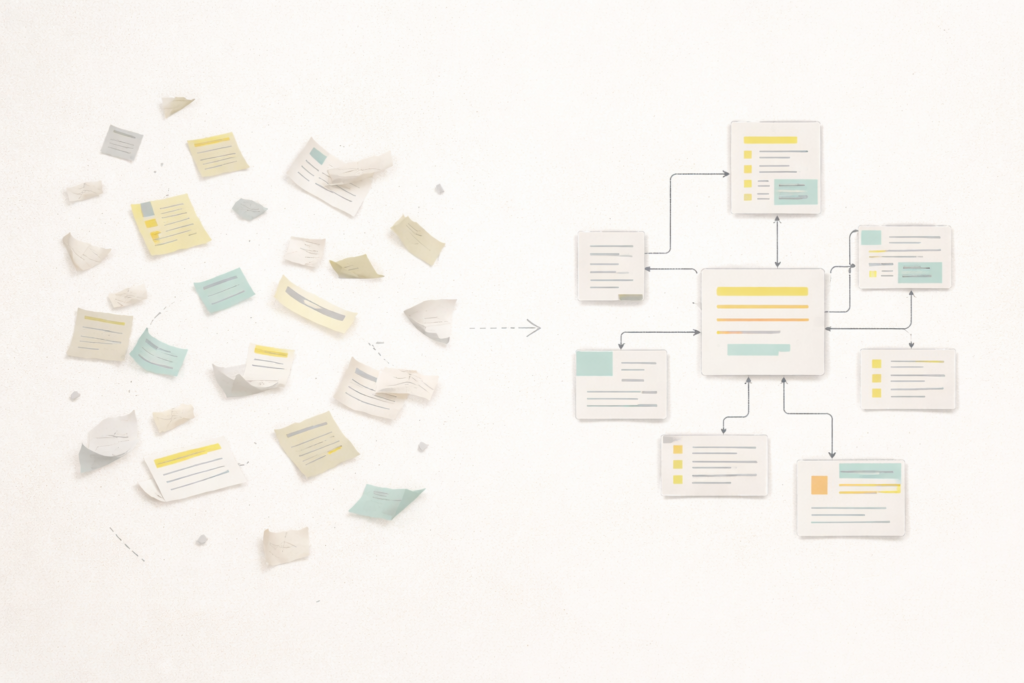
What follows isn’t a guide to building the perfect system. It’s an attempt to clarify what a second brain actually means today, and how to approach it without turning it into another source of friction.
Why the Second Brain Idea Took Off in the First Place
The modern second brain idea gained traction in the late 2010s, largely because it spoke to a shared frustration. People felt overwhelmed by information and under-supported by their tools. Notes were scattered. Insights were forgotten. Interesting ideas resurfaced too late, if at all.
The early frameworks focused on capture, organisation, refinement, and expression (referred to as ‘CODE’). They encouraged people to treat their notes not as an archive, but as a living resource. For many, that alone was a significant improvement.
But the environment those systems were designed for has changed. We now live in a world where software can do much of the mechanical thinking for us. Summaries, highlights, task extraction, even early drafts can be generated automatically. At the same time, knowledge tools have shifted away from rigid folder structures toward more flexible, interconnected ways of working.
As a result, the original second brain models often feel slightly misaligned. Not wrong, exactly, and a still inherently plausible foundation, but now somewhat incomplete.
One of the biggest changes is that most people no longer struggle to capture information. The real difficulty is deciding what to keep, what to ignore, and what to return to later. Saving everything is easy. Making sense of it is not.
Another shift is that a second brain is no longer a single app. It’s an ecosystem. Notes might live in one place, files in another, automations somewhere else entirely, with AI quietly stitching things together in the background. Thinking in terms of layers is often more useful than thinking in terms of tools.
Thinking in Layers Instead of Apps
At the foundation is the knowledge layer. This is where your notes, ideas, highlights, and references live. It’s the space where thinking happens. The best tools here don’t force you into a single structure. They let ideas evolve, connect, and change over time.
Above that sits the storage layer. This is less glamorous, but arguably more important. A second brain only works if it’s reliable. That means backups, redundancy, and a clear sense of where your information actually lives. Longevity matters. A beautifully organised system that disappears after a sync failure isn’t a second brain. It’s a risk.
Then there’s the automation layer. This is where modern systems quietly come into their own. When information flows automatically from one place to another, friction disappears. Highlights arrive without effort. Summaries appear where you need them. Inboxes stay manageable. Automation doesn’t need to be complex to be valuable. Even a single well-chosen workflow can make the difference between a system you maintain and one you abandon.
How AI Has Changed Personal Knowledge Management
Finally, there’s the intelligence layer. This is the most recent addition, and the one that changes the nature of the whole system. AI can now act as a kind of contextual memory, and should be treated as infrastructure rather than a novelty. It can help you resurface old ideas, explore connections you’d forgotten, or clarify half-formed thoughts. Used carefully it doesn’t replace thinking, it supports it.

Why Most Second Brain Systems Eventually Break Down
Most second brain systems don’t fail because people lack discipline. They fail because they’re designed around the wrong assumptions.
People start with tools instead of habits. They build elaborate structures before they’ve taken enough notes to justify them. They copy templates designed for someone else’s life. They collect endlessly but rarely review. They rely on manual upkeep in systems that demand consistency.
A practical second brain looks far less impressive than the ones you see online. It’s usually a little messy. It evolves slowly. It prioritises ease over elegance. Designing workflow structure devoid of app dependency will always survive tool changes.
In practice, it often starts with simple capture. Saving things in the moment, without worrying too much about where they belong. A weekly or fortnightly review to turn raw material into something usable. A basic backup strategy that runs quietly in the background. One or two automations that remove obvious friction. And a regular habit of pruning what no longer matters.
The goal isn’t completeness, in that knowledge can’t be ‘completed’. It’s trust, dependency and usefulness.
Tool choice matters, but not in the way it’s often presented. Different tools suit different kinds of thinking. Some people thrive with visual, spatial layouts. Others prefer plain text and local files. Some value privacy above all else. Others want seamless collaboration. There is no universal “best” setup.
A sensible starting point in 2026 is a small stack that covers the basics: somewhere to think, somewhere to store, something to automate the boring parts, and an AI assistant that helps you reflect rather than distracts you. Complexity can come later, if it’s needed at all, the priority is a practical PKM stack that actually works together.
If you want to start today, the barrier doesn’t need to be high. Create a single inbox for ideas. Install one tool that captures what you read. Set up one automation that saves you time. That’s enough to build momentum.
Where Personal Knowledge Systems Are Heading Next
Looking ahead, second brains are likely to become more multimodal. Voice, images, video, and transcripts will blend more naturally with text. AI agents will increasingly manage the background maintenance. Data ownership and resilience will matter more as personal systems grow more interconnected.
But the underlying goal will remain the same.
A second brain isn’t about building the most impressive system. It’s about reducing cognitive load, supporting good thinking, and giving ideas a place to mature.
You don’t need a perfect system. You need one you trust and use instinctively as frictionlessly as possible.
That’s something you build gradually, through use, not design.